
Power generating companies (gencos) that use imported coal to produce electricity, may find it difficult to switch on their idle units immediately in the wake of high fuel costs, several players have told Business Standard. Recently, the Union power ministry had invoked Section 11 of the Electricity Act mandating all imported coal-based plants to generate power at full capacity. However, some generating companies that use imported coal, argue that it is simply unviable for them to produce power when the price of coal in the international market is high, while the per-unit price of power has been capped at Rs 12 per unit on the domestic power exchange.

The government on Thursday more than doubled the price of natural gas that is used to produce electricity, make fertilisers, turned into CNG and piped to household kitchens for cooking, on the back of a spike in global energy prices. The price of gas produced from old regulated fields, such as the nation's largest gas field of Bassein of ONGC, will rise to a record high of $6.10 per million British thermal unit (mmBtu) from the current $2.90 per mmBtu, according to the oil ministry's Petroleum Planning and Analysis Cell (PPAC). The new price, which is likely to result in a hike in CNG and piped cooking gas rates, will be for six months beginning April 1.
Reliance announced energy asset sales worth around $ 16 billion; end of the investment cycle in telecom; bringing net-debt to zero in 18 months; value-unlocking options for real estate and financial assets; listing of telecom and retail in five years; and focus on dividends.
.jpg)
For India to invoke "sovereign" or "state" immunity to safeguard its foreign assets, which are under threat of getting seized in the intensifying legal battle with Cairn Energy, may come with several riders. Experts point out that the Indian government has to first satisfy the French court that the properties or assets that are under consideration are being used to dispense the state's sovereign functions.

India always faces a Hobson's choice as far as feeding coal-fired generators goes - even if the government is reluctant to admit it. The country cannot do without shipping in the world's most polluting fuel from overseas. And it will continue to do so unless it decides to reduce demand by forcing citizens, farmers and businesses to live without electricity for part of the day, or use diesel generators to fire facilities.

Dr Bhabha and Dr Sarabhai didn't feel guilty for their ambitions; it was for those 'mad scientists' that India is a powerhouse -- both at the atomic level and in the vastness of space, observes Kumar Abishek.

ITC was the top gainer in the Sensex pack, rallying over 7 per cent, followed by Reliance Industries, ONGC, Tata Steel, Tech Mahindra, Sun Pharma and SBI. On the other hand, IndusInd Bank plunged nearly 15 per cent. Maruti, Bajaj Finance and Titan were the other laggards.

Owing to a big rise in the market capitalisation of group companies such as Adani Green Energy and Adani Transmission, the group promoters, the Gautam Adani family, have closed the wealth gap with Mukesh Ambani, the promoter and owner of Reliance Industries Ltd (RIL). Ambani continues to top India's billionaire league table. The Ambani family's net worth was estimated to be Rs 8.06 trillion (around $108 billion) on Tuesday against the Rs 6.87 trillion (around $92 billion) of the Adani family.

Ajit Mishra, vice president, Research, Religare Broking, answers your queries.

Despite a massive underperformance at the bourses since the last six months, analysts are turning optimistic on Reliance Industries (RIL). Those at Jefferies, for instance, say that the company is a proxy play for India's consumption growth story. The key catalysts for the stock, according to a Jeffries note, include faster-than-expected market share gain in retail, oil-to-chemicals (O2C) stake sale, recovery in gross refining margins (GRM), potential public listing of Jio and even a possible banking licence going ahead. That apart, analysts feel any tariff hike in Reliance Jio (RJio) - its telecom venture - will also aid performance. With balance sheet adequately de-levered, proceeds from a strategic stake sale in the O2C business will create a sizeable war chest for the company, analysts say.

The fixed line broadband will offer "ultra high-definition entertainment on large screen TVs, multi-party video conferencing from your living room, voice-activated virtual assistants, virtual reality gaming, digital shopping, immersive experiences," Ambani said.

Sensex opened with a negative gap of 325 points at 14,452. The index barely managed to touch a high of 14,484, and then started slipping deeper into red.

ONGC was the top gainer in the Sensex pack, rallying around 6 per cent, followed by IndusInd Bank, L&T, UltraTech Cement, Titan, SBI and NTPC. NSE Nifty settled 32.10 points up at 14,707.80.

ONGC was the top loser in the Sensex pack, shedding 4 per cent, followed by Bharti Airtel, SBI, IndusInd Bank, NTPC, Sun Pharma and ITC. On the other hand, Bajaj Finance, Bajaj Auto, Reliance, Bajaj Finserv and Asian Paints were among the gainers.

Finance Minister Nirmala Sitharaman on Tuesday unveiled a Rs 39.45 lakh crore Budget with a view to fire up the key engines of the economy to sustain a world-beating recovery from the pandemic. This was Sitharaman's fourth Budget. While the taxpayers were left in the lurch, once again, was she able to cheer Corporate India?

UltraTech Cement was the top gainer in the Sensex pack, rising 3.06 per cent, followed by IndusInd Bank, ICICI Bank, HDFC Bank, Titan, Axis Bank, SBI and Reliance Industries. NSE Nifty advanced 78.35 pointsto close at 14,814.75.

While consumer electronics, technology, mobile phones, auto and sports-wear categories dominate the top 20, FMCG has only one entry in the list

Jason Holder could well turn out to be one of the most expensive buys at this edition of IPL

If IOC is not allowed to run its own affairs, then we can see it close down in the next 10 to 15 years, warns Sudhir Bisht.

Benchmark stock indices Sensex and Nifty tumbled nearly 1 per cent on Wednesday due to profit booking in banking, financial and IT stocks after a recent rally. The 30-share BSE Sensex plunged 537.22 points or 0.94 per cent to end at 56,819.39 as 24 of its stocks declined. During the day, it tanked 772.57 points or 1.34 per cent to touch a low of 56,584.04. The broader NSE Nifty declined by 162.40 points or 0.94 per cent to 17,038.40 with 39 of its constituents ending in the red. Bajaj Finance was the biggest loser among Sensex stocks, dropping by 7.24 per cent.

As fuel prices surged in September, the government's decision to ask companies to cut price by Rs1 each on a litre of petrol and diesel came as a dampner for private players.

Bajaj Finance was the top loser, tumbling 4.68 per cent, followed by Tech Mahindra, IndusInd Bank, ICICI Bank, SBI, Reliance Industries, Bharti Airtel and HCL Tech. NSE Nifty crashed 290.70 points or 2.43 per cent to 11,680.35.

The Central Bureau of Investigation on Monday filed its first charge-sheet in a Delhi court in the coal blocks allocation case against Navabharat Power Pvt Ltd for allegedly misrepresenting facts and making "fraudulent" claims to "embellish" its applications to get allotments between 2006 and 2009.

While Mukesh Ambani-led RIL posted a 108 per cent YoY rise in profit after tax for Q4FY21 at Rs 13,227 crore, it fell short of Bloomberg estimate of Rs 13,704 crore.

So which sectors are likely to do well in 2022? Should you focus on domestic economy-related sectors or export-oriented ones?
Stock market barometers Sensex and Nifty ended marginally higher on Monday as rise in wholesale inflation capped early gains despite a positive trend in global markets. The 30-share index settled 32.02 points or 0.05 per cent higher at 60,718.71 with half of its constituents ending in green. The broad based Nifty edged up 6.70 points or 0.04 per cent to close at 18,109.45.

Bharti Airtel, Bajaj Finance, Bajaj Auto, Reliance Industries, Tata Motors, SBI, HUL, NTPC, ONGC, ITC and Asian Paints rose up to 2.19 per cent.
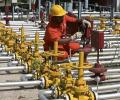
India's natural gas production is projected to jump by 52 per cent to 122 million standard cubic metres per day by 2024 as state-owned Oil and Natural Gas Corporation (ONGC) and Reliance Industries Ltd-BP combine raise output from the KG basin fields. Natural gas production in 2019-20 was 85 mmscmd, which is estimated to have fallen to 80 mmscmd in the following year, HDFC Securities said in a report. The output is projected to rise in the current fiscal that started on April 1 to 93 mmscmd, 107 mmscmd in the following year and 122 mmscmd in 2023-24, the brokerage estimated.

'We began foolishly bragging about Saudi-Emirati investment plans as indicative of the sheikhs 'distancing' from Pakistan, including on Kashmir,' notes Ambassador M K Bhadrakumar.

Saturday will be the last time the Mumbai Mirror will hit newsstands as a daily. Two Saturdays ago, its owners, the Times of India group, shocked the city by deciding to convert the Mirror into a weekly newspaper. Jyoti Punwani salutes the Mirror and its editor, Meenal Baghel, for its pathbreaking journalism.

Reliance Industries Ltd (RIL) was the star performer in Friday's session, spurting over 6 per cent to its all-time high, Other Sensex gainers included Bajaj Finance, PowerGrid, ICICI Bank, Maruti, Axis Bank and SBI. On the other hand, IndusInd Bank, HCL Tech, ITC, M&M HDFC and Infosys shed up to 2.94 per cent.

Prime Minister Narendra Modi on Saturday said the target date for achieving 20 per cent ethanol-blending with petrol has been advanced by five years to 2025 to cut pollution and reduce import dependence.

RIL's Dubai-based subsidiary Reliance Exploration & Production DMCC "signed the completion documents for divestment of its 25 per cent working interest in the Yemen's Block-9 to Medco Yemen Malik Ltd, a wholly-owned subsidiary of PT Medco Energi Internasional Tbk of Indonesia," the company said in a statement.

Foreign portfolio investors (FPI) remained net buyers in Indian markets in October so far, pumping in a net Rs 17,749 crore in the month as better than expected quarterly results, the opening of the economy, and resumption of business activities kept investors' interest intact. In equities, FPIs invested a net sum of Rs 15,642 crore and the debt segment saw an inflow of Rs 2,107 crore during October 1-23, the depositories data showed. The total net investment during the period under review stood at Rs 17,749 crore.

Earlier in May, Ford India announced that it had dropped its plans to make electric vehicles (EVs) in India, which it intended to export, under the production-linked incentive scheme (PLI). Ford was among 20 companies that had signed a Champion OEM Incentive Scheme under the PLI project with the government in February this year. The decision comes as a blow for the 4,000-odd employees at Ford India's Maraimalai Nagar plant near Chennai and in Sanand, Gujarat. In September last year, the company had announced that it would exit the India market, which it had entered in 1995 through an on-again, off-again joint venture with Mahindra & Mahindra (they split in 1998, signed a JV in 2019 and split again in December 2020), retailing petrol and diesel brands such as the EcoSport, Figo, Aspire, and Endeavour.

The stake sale follows Mukesh Ambani-run firm exiting from two oil blocks in Kurdistan region of Iraq.

Equity benchmarks Sensex and Nifty ended marginally lower on Tuesday as investors booked profits at higher levels amid a mixed trend in global markets.

Bharti Airtel was the top gainer in the Sensex pack, rising around 4 per cent, followed by Tech Mahindra, HDFC, Kotak Bank, M&M and HCL Tech. NSE Nifty advanced 21.85 points to 16,280.10.

The Tata group is looking to make a foray into semiconductor (also known as chips) manufacturing and it has set up a business to seize the opportunity, Chairman N Chandrasekaran said on Monday. "At the Tata group, we have already pivoted into a number of new businesses like electronics manufacturing, 5G network equipment as well as semiconductors, in all probability," he said while speaking at the annual general meeting of the IMC Chamber of Commerce and Industry. Chandrasekaran said global supply chains, currently heavily dependent on China, would see a big change in a post-pandemic world with businesses shifting their reliance to other countries.

Despite unprecedented levels of uncertainty in Samvat 2077, investors have little to complain about on the returns front. The BSE Sensex delivered returns of 38 per cent in this period, while the Nifty registered a return of over 40 per cent. As is the case in bull markets, companies in the small- and mid-capitalisation basket outperformed the benchmarks, with returns almost twice those of frontliners.
 © 2026 Rediff.com - Advertise with us - Disclaimer - Privacy Policy - Sitemap - Feedback - About us - Terms of use - Grievances